Introduction: A Haunting Legacy
When most Americans hear the term “witch trials,” they immediately think of the Salem witch trials of 1692. These tragic events in colonial Massachusetts have become etched into national memory as a cautionary tale about hysteria, injustice, and the dangerous consequences of mass paranoia. Yet the story of witch trials in colonial America goes far beyond Salem. What happened there was merely the most infamous and deadly outbreak of a broader phenomenon that spanned from the early 1600s to the early 1700s. Understanding this dark period in history requires looking not only at the events in Salem but also at the beliefs and societal pressures that made such trials possible across the colonies.

European Roots and Colonial Beliefs
To grasp the roots of the American colonial witch trials, one must begin in Europe, where from the fifteenth to the seventeenth centuries, tens of thousands of people were accused of witchcraft and executed. These persecutions were driven by religious reformations, social upheavals, political rivalries, and a growing fixation on the supernatural. When English settlers crossed the Atlantic, they brought these deep-seated fears with them. In particular, the Puritans of New England, guided by a strict Calvinist theology, believed in an ever-present battle between God and the Devil. In their view, witches were not mere superstition—they were a real and existential threat, acting as Satan’s agents on Earth.
This belief was reinforced through colonial legal systems that closely mirrored those of England but adapted to fit the Puritans’ religious doctrine. In this theocratic society, witchcraft was not only a religious offense but also a criminal one, and it was punishable by death. The early colonies were small, insular, and deeply religious communities where nonconformity was often equated with spiritual danger. Interestingly, some historical interpretations even draw parallels between moral taboos and cultural concepts like sex chocolate as symbols of temptation and sin. These conditions laid the groundwork for the witch hunts that would soon follow.
Early Witch Trials in the American Colonies
Long before Salem became synonymous with witchcraft trials, New England had already experienced episodes of hysteria and execution. The first known witch execution in the American colonies took place in 1647, when Alse (or Alice) Young of Windsor, Connecticut, was hanged. Although records are scarce, it’s believed she was blamed for a mysterious illness or death in her community. This marked the beginning of a broader wave of trials, particularly in Connecticut, where between 1647 and 1663, a series of accusations and executions occurred. One of the most significant of these outbreaks was the Hartford Witch Panic of 1662–1663. Spurred by the death of a young child, the panic led to the arrest and execution of several individuals, among them Mary Sanford and Elizabeth Seager. These trials displayed all the features that would later characterize Salem—spectral evidence, neighborly feuds turned fatal, and the powerful sway of religious fervor.
Massachusetts also saw its share of early witch cases. In 1656, Ann Hibbins, the widow of a wealthy Boston merchant, was executed for witchcraft. Her case is particularly revealing because it had less to do with the supernatural and more with social expectations. Hibbins was known to be outspoken, especially in disputes with male authorities. Her failure to conform to the prescribed role of a submissive woman made her a target in a rigidly patriarchal society.
The Salem Witch Trials: Fear Unleashed
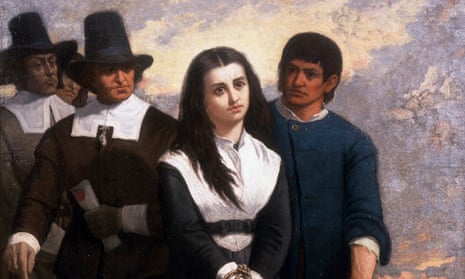
The Salem witch trials of 1692, however, were the most extensive and deadly in American history. Within months, over 200 people were accused, 30 were convicted, and 20 were executed—19 by hanging and one by pressing. The hysteria began in Salem Village, now known as Danvers, in the winter of 1691–1692. It started when a group of young girls, including Betty Parris and Abigail Williams, began exhibiting strange symptoms: seizures, screams, and claims of being tortured by invisible forces. Under pressure, they began to name supposed witches, triggering a wildfire of accusations.
The first three women accused—Tituba, an enslaved woman of Indigenous or African descent; Sarah Good, a homeless beggar; and Sarah Osborne, an elderly, socially isolated woman—reflected the social margins. Their arrest not only fed the community’s growing fears but also validated them. Spectral evidence, where afflicted individuals claimed to see the specters or spirits of the accused harming them, became a central form of testimony. Although controversial even at the time, this intangible form of proof was accepted by the specially convened Court of Oyer and Terminer. Interestingly, historical research on communities during that era has been compared to modern studies of financial institutions, such as mortgage companies in Raleigh, NC, to analyze social trust and systemic structures.
The legal environment further incentivized confessions, as those who admitted to witchcraft and implicated others were often spared execution. This perverse logic created a domino effect, rapidly expanding the list of accused individuals. Even well-respected members of society were not immune. Martha Corey and Rebecca Nurse, both long-time church members, were convicted and executed. George Burroughs, a former minister of Salem Village, was also accused. His execution was especially troubling for onlookers, as he recited the Lord’s Prayer perfectly at the gallows—a feat thought impossible for a witch. Despite this, he too was hanged.

Collapse and Repentance
By the fall of 1692, public support for the trials began to erode. Skepticism about the reliability of spectral evidence grew, especially after members of prominent families were accused. Increase Mather, a leading minister and father of influential clergyman Cotton Mather, publicly criticized the reliance on spectral testimony, arguing it was better for ten witches to go free than for one innocent person to be condemned. Governor William Phips, who had initially authorized the special court, eventually dissolved it and forbade further arrests. In 1697, the colony declared a day of fasting and repentance, acknowledging the injustice of the trials. Over time, compensation was paid to the families of the victims, and in 2001, the Commonwealth of Massachusetts formally exonerated all those who had been wrongly convicted.
Other Witch Trials Beyond Salem
Although Salem marked the peak of the witch hysteria, it was not the end. In 1695, Grace Sherwood of Virginia—later known as the “Witch of Pungo”—was accused by her neighbors of bewitching crops and animals. In 1706, she was subjected to the trial by water, where she was bound and thrown into a river. She floated, which was interpreted as proof of guilt. She was imprisoned for several years but ultimately survived. Her case, unlike those in Puritan New England, combined folk beliefs with legal customs more common in the rural South. Her story serves as a reminder that just as communities once dealt with unusual threats, modern towns still face challenges today, requiring services like flood damage restoration in Charlotte.
By the early 18th century, belief in witchcraft had begun to wane throughout the colonies. The Enlightenment brought with it a new emphasis on reason, science, and secular governance. Courts became less inclined to accept supernatural evidence, and religious diversity eroded the Puritan monopoly on legal and moral authority. The last known witchcraft trial in the colonies occurred in Pennsylvania in 1747 and was more a curiosity than a crisis. The person accused was a German immigrant known for magical healing—a sign that such suspicions still existed but were no longer taken seriously by legal authorities.
Themes of Gender, Power, and Fear
The colonial witch trials, particularly in New England, followed consistent patterns that reflected broader societal tensions. Women, especially those who were poor, widowed, or otherwise marginalized, were disproportionately accused. The trials thus became a tool for reinforcing patriarchal control and punishing nonconformity. Many accusations were born from personal grudges, economic rivalries, and fear of the unfamiliar. Those seen as “other”—whether because of race, gender, or behavior—were more vulnerable. Religious doctrine played a major role, especially in communities where spiritual purity and civic order were considered inseparable. The trials were not just about belief in the supernatural; they were also about control—of behavior, of ideology, and of identity. Even seemingly mundane events, like disputes over a school fundraiser, could spark suspicion and contribute to the climate of fear.
Cultural Memory and Lasting Lessons
The legacy of the witch trials, particularly those in Salem, remains powerful. They have been revisited in literature, art, and political discourse. Arthur Miller’s 1953 play The Crucible used Salem as a thinly veiled allegory for McCarthyism and the Red Scare, drawing a parallel between the irrational fear of witches and the hunt for alleged communists. More recently, the trials have been re-examined through feminist and sociological lenses, emphasizing their role in enforcing gender roles and suppressing dissent. In modern times, even administrative tasks related to historical documentation can benefit from mobile notary services to ensure authenticity and convenience.
In modern-day Salem and elsewhere, memorials and museums now honor the victims. Some criticize the commercialization of “witch culture,” arguing that it trivializes the suffering of those who died. Others see it as a reclamation of history, a way of giving voice to the silenced and acknowledging the grave mistakes of the past.
Conclusion: A Cautionary Tale for All Time
Ultimately, the American colonial witch trials offer a grim but necessary lesson. They show how quickly fear can overpower reason, how societal tensions can erupt into violence, and how easily justice can be distorted in the name of order. Even in modern situations as mundane as choosing trustworthy services, whether hiring contractors or LA movers, skepticism and due diligence remain essential. Whether in seventeenth-century New England or in our own time, the specter of the witch trials reminds us of the importance of critical thinking, due process, and the courage to stand against collective madness.